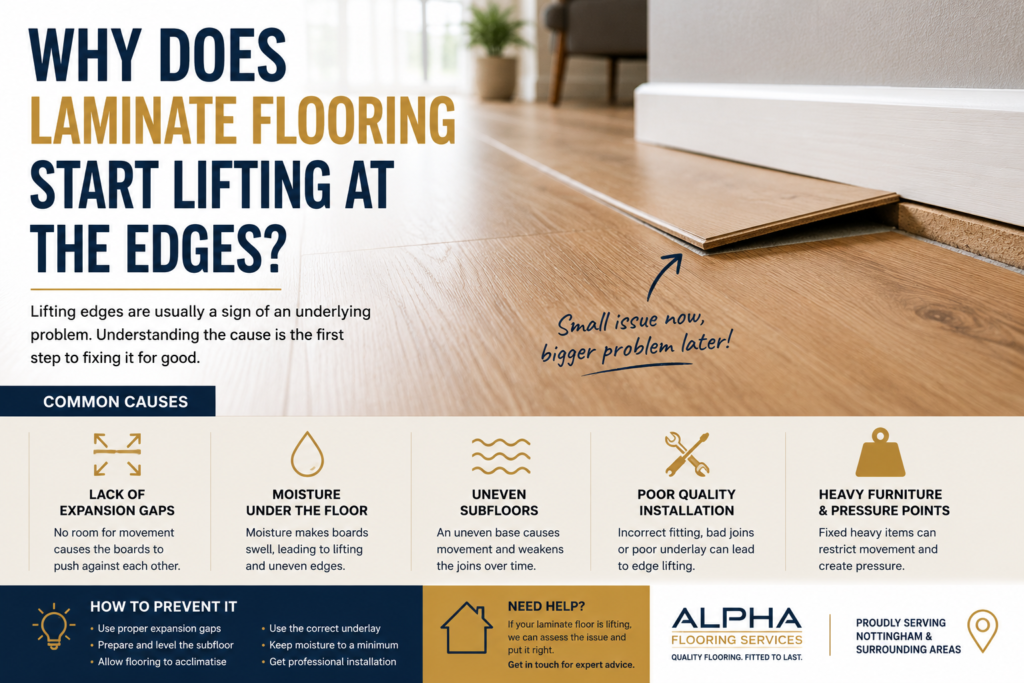
Why does laminate flooring start lifting at the edges? It’s one of the most common questions homeowners ask after installing a new floor. One minute everything looks smooth and perfect, then suddenly corners start rising, joins begin separating, and certain boards feel uneven underfoot.
The good news is that laminate flooring doesn’t usually start lifting for no reason. In most cases, there’s an underlying issue causing pressure or movement beneath the surface. Understanding what causes it can help you prevent expensive repairs later on.
At Alpha Flooring Services, we’ve seen plenty of laminate problems across Nottingham and the surrounding areas. Most of them come down to installation, moisture or poor preparation.
Lack of Expansion Gaps
The biggest reason people ask why does laminate flooring start lifting at the edges is because expansion gaps were either too small or missed entirely during installation.
Laminate flooring naturally expands and contracts with changes in temperature and humidity. If there’s no room for movement around the edges of the room, pressure builds up and the boards begin pushing against each other.
That pressure usually shows itself around doorways, skirting boards or room edges where the floor starts lifting.
This is why professional floor fitting in Nottingham is so important. Correct spacing during installation prevents these issues before they start.
Moisture Under the Floor
Another major reason behind why does laminate flooring start lifting at the edges is moisture. Laminate and water rarely get along for long.
If moisture rises from the subfloor or water seeps into the joins, boards can begin swelling. Once swollen, the edges often rise unevenly and create that familiar lifting effect.
Kitchens, hallways and rooms with poor ventilation are common trouble spots. Even small leaks or repeated wet mopping can cause gradual damage over time.
If moisture resistance is a concern, many homeowners now consider LVT flooring as an alternative because it handles water much better than laminate.
Uneven Subfloors
Sometimes the answer to why does laminate flooring start lifting at the edges has nothing to do with the laminate itself. The issue may actually be underneath.
If the subfloor isn’t level before installation, laminate boards can flex when walked on. Over time, repeated movement weakens the joins and causes edges to rise.
We often see this in older Nottingham properties where timber floors have shifted slightly over the years. Proper preparation and levelling are essential before any flooring goes down.
Our guide on floor installation services explains why preparation is one of the most important stages of any flooring project.
Poor Quality Installation
Unfortunately, poor installation is another common answer to why does laminate flooring start lifting at the edges.
Boards that haven’t been clicked together properly can separate over time. Cheap underlay, rushed fitting or incorrect trimming around the edges can all contribute to movement.
This is one reason why experienced installers matter. A floor might look fine on day one, but small mistakes during installation often show themselves months later.
Heavy Furniture and Pressure Points
Large furniture can also play a role in why does laminate flooring start lifting at the edges. Laminate floors are designed to “float”, meaning they need freedom to move slightly.
Very heavy furniture fixed tightly against the floor can restrict movement and create pressure in certain areas. That pressure then transfers across the boards, leading to lifting elsewhere in the room.
It’s another reason why proper planning during installation matters.
Can Lifting Laminate Flooring Be Fixed?
In some cases, yes. If the issue is caught early, sections of flooring can sometimes be lifted and reinstalled correctly. Moisture problems may require replacing damaged boards and improving ventilation or damp protection.
However, if lifting has spread across multiple areas, a larger repair may be needed.
Homeowners comparing alternatives often explore guides like laminate vs wood flooring when deciding whether to replace damaged laminate entirely.
How to Prevent Laminate Flooring from Lifting
The best way to avoid asking why does laminate flooring start lifting at the edges is to get the installation right from the start.
That means:
Using proper expansion gaps.
Ensuring the subfloor is level.
Allowing the flooring to acclimatise before fitting.
Using the correct underlay.
Avoiding excessive moisture exposure.
Most importantly, work with experienced professionals who understand how laminate behaves over time.
Final Thoughts
If you’ve noticed raised joins or uneven edges, there’s usually a clear reason behind it. Understanding why does laminate flooring start lifting at the edges can help you fix the issue before it becomes more serious.
At Alpha Flooring Services, we help homeowners across Nottingham diagnose flooring problems, repair damaged areas and install new floors correctly the first time.
If you need advice or a professional assessment, visit our contact page and we’ll be happy to help.